

Paradoxical Submission – Symbolic Violence. Literary and Cultural-Sociological Perspectives on Bourdieu’s “Masculine Domination”
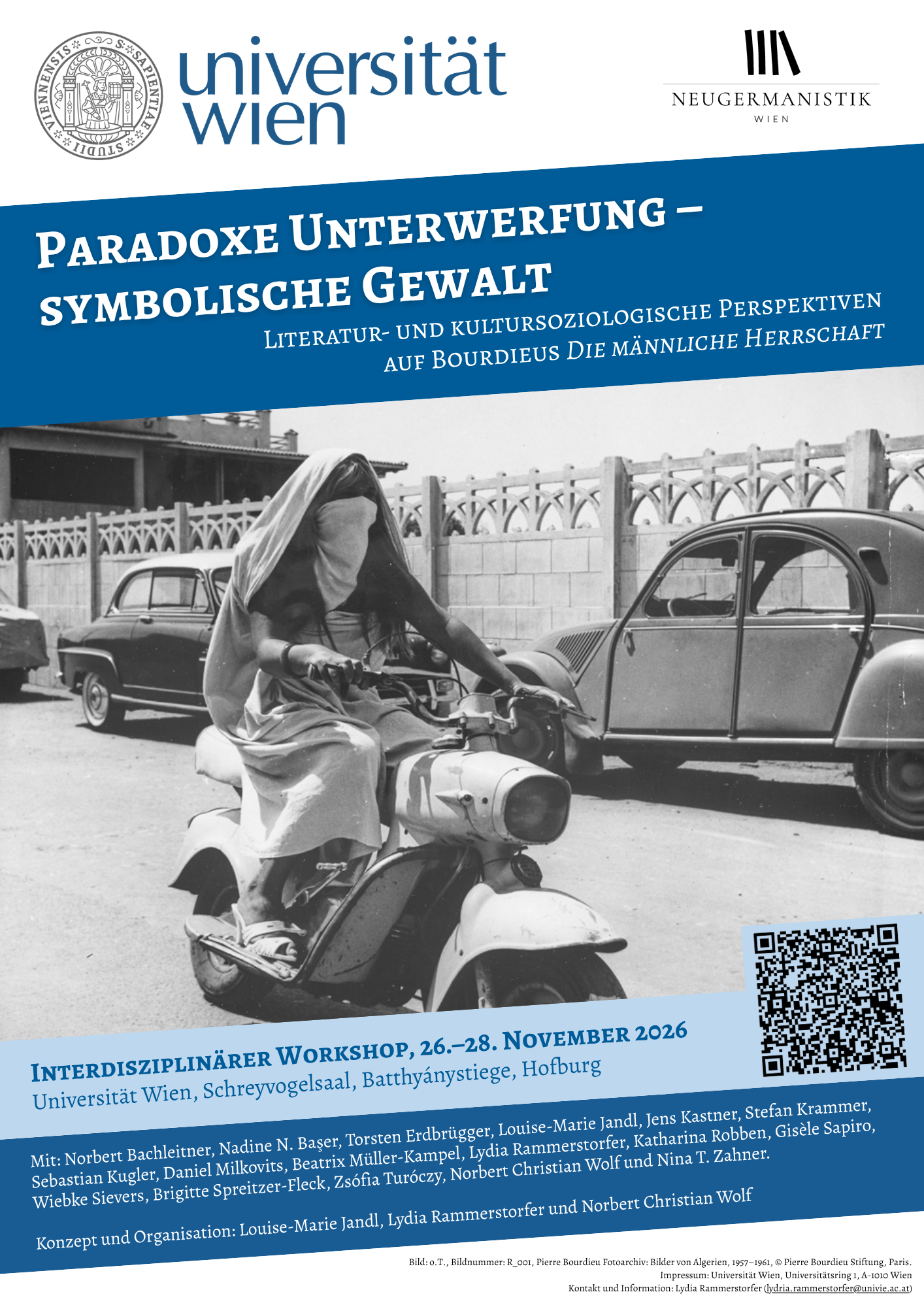
Workshop, 26–28 November 2026, University of Vienna, Schreyvogelsaal (Hofburg)
Convenors: Louise-Marie Jandl, Lydia Rammerstorfer, Norbert Christian Wolf (all University of Vienna)
Keynote: Gisèle Sapiro (Paris)
In Masculine Domination (1998), Pierre Bourdieu analyzes the gender order as a paradigmatic model of social dominance. Its effectiveness, he argues, rests on hidden mechanisms of symbolic violence – a subtle, culturally mediated form of power that inscribes itself deeply into the social world and the habitus. This “gentle, invisible violence, unnoticed by its victims” (Bourdieu 2021, 8) manifests, for instance, in the dichotomous allocation of gendered spaces, in the constant “being perceived” (Bourdieu 2021, 117) of the sexualized female body, and in the marginalization of women in science and the arts. The often unresisting transmission of this “masculine order” is, according to Bourdieu, grounded in the fact that it is not perceived as arbitrary but as self-evident. This “paradoxical submission” (Bourdieu 2021, 212) contributes to the stabilization and naturalization of the existing social order as a whole – an order that, precisely for this reason, typically remains unquestioned and thus invisible.
Despite its hiddenness, it is nevertheless possible to analyze these structures and, in a second step, to subvert them: In his major work of literary sociology, The Rules of Art, Bourdieu attributes to literature a particular capacity to “unveil” social power relations, suggesting that it may at times reveal more about the social world than certain “supposedly scientific texts” (Bourdieu 2014, 66–67). This assumption – which emphasizes both the epistemic potential of literary texts and their specific representational force – underpins Bourdieu’s exemplary analysis of Virginia Woolf’s To the Lighthouse (see Bourdieu 2021, 122–141), in which he demonstrates the analytical potential of literary procedures for making visible the concealed logic of masculine domination. A systematic engagement with the applicability of Bourdieu’s theory to the analysis of literary texts, such as the one he himself provides, remains to be undertaken, as does an exploration of its potential for reflecting on power relations within the literary and cultural fields.
This interdisciplinary workshop takes up that task. Bringing together contributions from literary studies and sociology, it examines the field through theoretical examples as well as case studies. The papers range from early feminist literature, sport and gender orders in Viennese modernism, censorship, crises of masculinity, and colonial power relations to current debates on the cultural sector, social media, and the politics of the manosphere. A publication of selected contributions as a special issue is planned.
Interested participants are welcome – registration is not required. For further information, please contact: lydia.rammerstorfer@univie.ac.at
Programme link: https://ucloud.univie.ac.at/index.php/s/2gx3XRjmJkkWX2p
Event will be mainly in german.