
Publishing Literary Self-Socioanalyses in Brazil
Carolina Pulici & Jéssica Ronconi
Given the determinants of publishing strategies, investigating the diffusion of self-socioanalyses reveals at the outset an unequal capacity of different publishing houses, as well as different countries, to import and export. The international circulation of Annie Ernaux’s work was “doubtless facilitated by the prestige of being published by Gallimard” (Hugeny-Léger, 2025, p. 3), which published 18 of her books in France and counts among the publishers with the greatest power of consecration demonstrated by their ability to export their authors (Sapiro, 2024, p. 40). It was, however, on the recommendation of the British publisher Fitzcarraldo, during the Frankfurt and London book fairs, that the Brazilian publishing house Fósforo decided to translate her work at the turn of the 2020s (Interview [1]).
Similarly, Édouard Louis, another French author associated with this literary genre, only became a publishing phenomenon in Brazil after being published by Todavia in 2023, following the direct intervention of his anglo-american literary agency, Wylie:
“When it reaches us, it’s already, in a certain way, filtered through a certain echo in Europe. It’s always the same, it comes to us later. […] Our daily work is always in contact with literary agents based in England, in the United States – less in France […] The case of Édouard Louis, in particular […], his agent is among the most powerful in the world […] And Annie Ernaux arrived by the same route […] through a kind of British filter, in reality, via Fitzcarraldo, a small English publishing house that has in these last few years published some very high level literary authors; it is through the English language that it began to resonate internationally ; it is rare that something comes directly from France.” (Interview II [2]).
Given that this literary form is predominant in rich, industrialized countries (Lammers and Twellmann, 2021), this text presents the preliminary findings of recently initiated research on the publication of literary self-socioanalyses in the context of a country like Brazil: a former Portuguese colony and the last western nation to abolish slavery (1888). This research is based on interviews with publishers responsible for the import, and, since 2023, for the domestic production of this literature, as well as on documentary analysis (promotional materials and press clippings).
A gamble on newcomers already rich in assets
In discussing new trends in literary production, Pierre Bourdieu (1999) observes that newcomers, by their very existence and the competition they introduce, threaten the established literary order. If this is the case, what has been described in France as a significant media and publishing interest in narratives of transfuges de classe (Véron and Abiven, 2024) has now arrived in Brazil, with critical and public acclaim, through three new publishing houses established over the past decade: Todavia (2016), Âyiné (2017), and Fósforo (2021).
Despite the lack of seniority, this central component of a publishing house’s symbolic capital is offset by other crucial assets, such as the influence of the catalog, which can be measured by the number of established writers and Nobel Prize winners it represents (Bourdieu, 1999, p. 4). Indeed, Fósforo published, in the very year of its founding in 2021, La Place [A Man’s Place] by Annie Ernaux, which was awarded by the Swedish Academy the following year. And the position of these 22 employees publishing house is defined by its possession of other significant resources, such as the presence, among its co-founders, of the widow of the editor-in-chief of Folha de S. Paulo, Brazil’s largest newspaper. In 2017, she launched, in partnership with a former journalist from Folha de S. Paulo, the magazine Quatro cinco um, dedicated to book reviews. Both have organized several editions of the Paraty International Literary Festival (FLIP), one of the leading instances of literary consecration in contemporary Brazil, which welcomed Annie Ernaux as its guest of honor in 2022. Finally, in 2020, this same co-founder established the Megafauna bookstore, located within the Copan Building (1966), one of São Paulo’s architectural landmarks designed by Oscar Niemeyer, Brazil’s most internationally renowned architect. In 2025, a new branch of the bookstore opened in another iconic building of Brazilian modernism: the Teatro Cultura Artística (1942), designed by the Italian-Brazilian architect Rino Levi, featuring an artistic fresco by Di Cavalcanti [Figure 1]. Thus, the history of Fósforo merges with that of other instances dedicated to promoting authors and books.
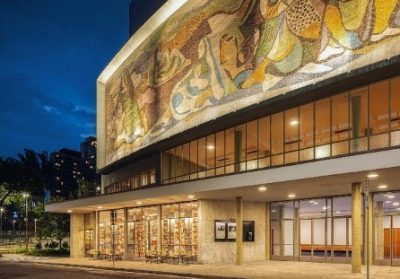
Figure 1: Megafauna Bookstore at Teatro Cultura Artística (São Paulo)
(source: https://www.livrariamegafauna.com.br/sobre-a-livraria/)
Like Annie Ernaux’s Brazilian publisher, Todavia, a mid-sized publishing house (34 employees) that has been publishing Édouard Louis’s books since 2023, has also predicted Nobel Prize winners in its catalog, specifically two: Polish author Olga Tokarczuk (2018) and South Korean author Han Kang (2024). In 2020, after only four years in business, it already ranked second among publishing houses in terms of the number of its authors nominated for the Jabuti Prize (Amado, 2020), one of the country’s most prestigious literary awards, trailing only Companhia das Letras, one of Brazil’s largest publishing groups, which combines symbolic capital with commercial power, and from which all of Todavia’s founders hail, with the exception of the son of the chairman of one of Latin America’s largest financial institutions, Itaúsa, the publishing house’s main investor at its founding (Maia, 2017).
In this context, Didier Eribon’s publisher, Âyiné, most closely resembles the ideal-typical condition of recent, small-scale publishing houses (8 employees), with limited economic capital and almost no institutionally recognized symbolic capital (Bourdieu, 1999, p. 11). Reluctant to attend the London and Frankfurt book fairs, the editor, who came across Eribon’s book by his own means rather than through recommendations from literary agents, foreign publishers, or scouts, observes: “Sometimes, to sell a book, they tell you, ‘Oh, this book was published by this or that publishing house. Us, we’ve never paid attention to that. It’s an advantage for us that… we speak many languages. We read many languages” (Interview III[1]). Founded thanks to the personal inheritance of a young Brazilian – the only editor who comes neither from the publishing world nor from São Paulo, who has been living in Venice for over twenty years – and to the investment in euros from an Italian co-founder (and his former professor), this publishing house derives one of its key strengths from its special relationship with Italy: “In our case, since we’re in Venice, there’s this positive side, perhaps, that there are many bookstores […] The two best ones sell almost exclusively books from independent publishers.”
By way of comparison, while the author of Retour à Reims [Returning to Reims] has reportedly sold around 8,000 copies since 2020, placing him third in Âyiné’s catalog in terms of sales (“Eribon is bigger than the publishing house,” Interview III), Édouard Louis, published by Todavia three years later, already counts 155,000 copies, making him the publisher’s second most selling author and Brazil the second-largest market, after France, for his bestsellers. Despite this, the Venice based publisher, which stands out for publishing comparatively few translations from English (even though it publishes more translations than any other), enjoys a certain prestige among critics and booksellers, notably thanks to its “off the beaten path catalog” (Meirelles, 2018), focused on Italian and Eastern European authors, such as Joseph Brodsky and Wisława Szymborska, winners of the Nobel Prize in Literature in 1987 and 1996.
This emblematic prize of the unification of the international literary scene (Casanova, 2008) demonstrates its quasi-universal recognition when, by awarding it to Annie Ernaux in 2022, it considerably reduces the time lag previously observed in the publication of her work in Brazil, which extends to the works of the entire line valued by the prize (Table I).
The characterization of the publishing houses of Annie Ernaux, Édouard Louis, and Didier Eribon suggests that the financial resources at their disposal, particularly in the case of the first two, do not necessarily place them in the most heteronomous segment of the Brazilian publishing landscape. This is evidenced by the absence of their titles from the list of the top twenty bestsellers of 2025 (Sobota, 2026), as well as the presence of Nobel Prize winners and Jabuti Prize finalists in their catalogs. As demonstrated by their visibility in the mainstream print media, “a form of recognition that is both symbolic and commercial” (Noël, 2012, p. 142), Fósforo, Todavia, and, to a lesser extent, Âyiné seem to occupy intermediate positions between the poles of financial power and symbolic power, as if they were following in the footsteps of Companhia das Letras, where one of Fósforo’s co-founders also began her career.
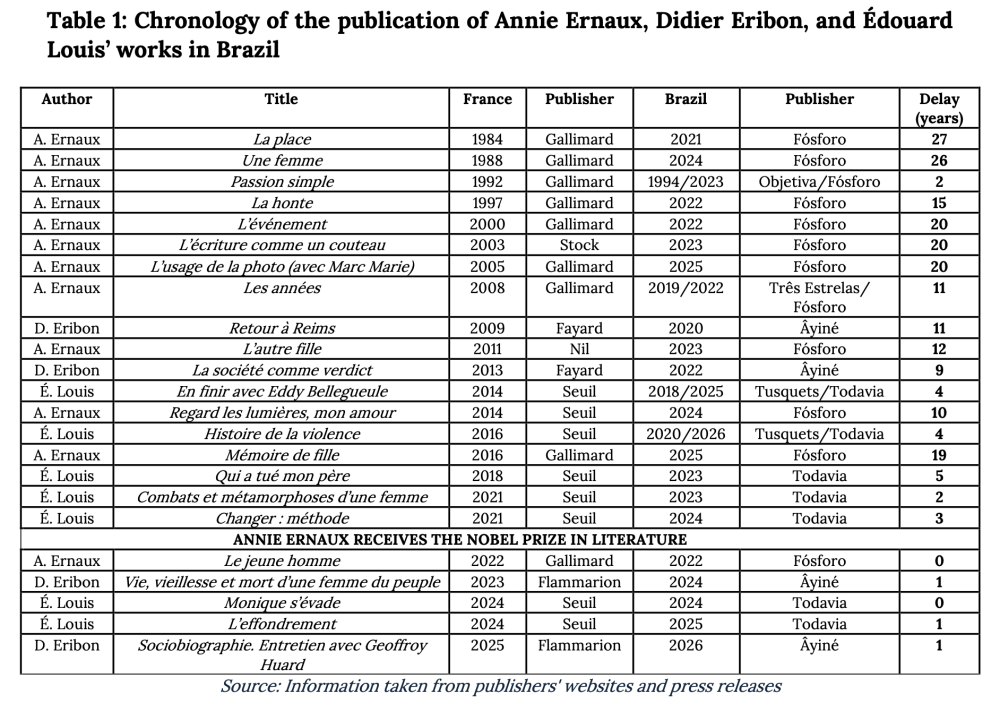
Source: Information taken from publishers’ websites and press releases
Strategies for the creation of a lineage
The dissemination of the prize awarded to Annie Ernaux with all of her “offspring” is reflected in the exchanges of recommendations and favors that take place within the interpersonal networks of editors from different countries (Bourdieu, 1999). Thus, during the Nobel Prize ceremony in Stockholm, while the laureate’s editors were gathered, the British publishing house Fitzcarraldo, which had already offered to acquire the first book by José Henrique Bortoluci, a Ph.D. in sociology from the University of Michigan and a lecturer in Brazil, encouraged other publishers to do the same, thus helping ensure that O que é meu [What is Mine] was sold to ten foreign publishers even before its publication in Brazil, including the Dutch Arbeiderspers, the Swedish Norstedts, and the Spanish Random House (Gabriel, 2023), which, like Fitzcarraldo, was already publishing Annie Ernaux: “They are interested in this type of narrative [of a transfuge de classe] […], but I have no doubt that the entry of the English editor made other editors take notice and become interested in the book” (Interview I).
The attempt to attach the three French and two Brazilian authors recently published by Fósforo to a lineage that can be traced back to Bourdieu, as argued by a literary critic (Angiolillo, 2023), is also evident in the editorial work shaping their reception in the public space through book covers, back covers, and even the physical space of bookstores [Figure 2]. Thus, in the promotional material for La Place [A Man’s Place], we read: “one of France’s most important living writers […] who, decades later, would serve as a declared inspiration to major figures in global autofiction and to leading names in French literature such as Édouard Louis and Didier Eribon.” Similarly, Todavia places Combats et métamorphoses d’une femme [A Woman’s Battles and Transformations] “in a tradition which leads back to Annie Ernaux and Didier Eribon.” While this is not the case with Âyiné (“I don’t like to use one author to sell another”) (Interview III), Eribon nevertheless writes blurbs for foreign editions of Bortoluci’s book, such as the German edition published by Aufbau, just as Annie Ernaux does for Fitzcarraldo and Random House.
Finally, the same logic of elevating the debut author to the level of their prestigious predecessors (Sapiro, 2024, p. 67) appears in the synopsis of A boba da corte [The Court Jester], by Tati Bernardi, a screenwriter, podcaster, and highly publicized columnist for Folha de S. Paulo, published by Fósforo: “If the theme has already been extensively explored by Annie Ernaux, Didier Eribon, Édouard Louis, and, in Brazil, by José Bortoluci, among others, in A boba da corte Bernardi takes the tradition of autosociobiography even further, adding layers of irony and humor to narratives of class transition.” Her inscription in this lineage predates the book’s publication, as Bernardi had led reading groups for Ernaux’s novels under the auspices of Fósforo itself. She had also participated, in the 2024 edition of FLIP, in a roundtable discussion alongside Édouard Louis, whose coverage in the major national press helped turn the French writer’s work into a market phenomenon in Brazil rather than merely a niche one (Interview II).
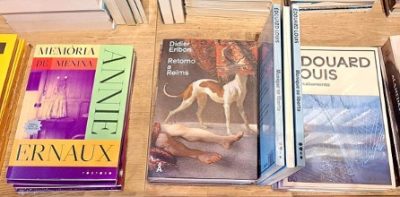
Figure 2: Livraria da Tarde, in São Paulo, 10.10,2025.
(Credit: Carolina Pulici)
If the importation of an author also depends on book clubs and other alternative channels for promoting books and connecting with readers, in Louis’s case, these interactions are amplified by his personal involvement in promoting his work on social media, on Brazilian television shows, and, in March 2026, through his participation in the Mostra Internacional de Teatro de São Paulo (MITsp). Confirming the importance, for an author’s commercial success, of their dissemination through other cultural products beyond the book (Florimond-Clerc and Gabrysiak, 2025), the adaptation of Qui a tué mon père [Who Killed My Father], produced by the Schaubühne Berlin and the Théâtre de la Ville de Paris, was directed by Thomas Ostermeier himself, who, in 2019, had adapted Retour à Reims [Returning to Reims] within a French context, thereby contributing once again to the consolidation of a lineage.

Figure 3: Édouard Louis onstage in a (new) adaptation by Thomas Ostermeier in São Paulo.
(Credits: MITsp and Jean-Louis Fernandez. Source: https://www.instagram.com/p/DVbul8aDZ2_/?img_index=2.)
Homogenization of catalogues and the preservation of traditional cultural import-export
Our initial results lead us to believe that the importation of literary self-socioanalyses into the Brazilian context of the 2020s primarily reveals the unifying and homogenizing dynamics of the publishing market and, consequently, the “growing isomorphism” of catalogs (Sapiro, 2024). Thus, in explaining why it entered the race for the distribution rights to Édouard Louis’s work in Brazil, Todavia acknowledges that the affinity between this literature and its developing catalog “obviously has to do with this circuit, which is a well-defined circuit of literary agents and countries where these authors find success. […] a Romanian author who hasn’t gone through this circuit of literary agents isn’t just going to arrive out of nowhere and come here. No matter how good the book is.” (Interview II)
The assertion that the authors most likely to be translated in Brazil are those who fit into the circuit defined by major anglo-american literary agents, as well as those who have achieved success in certain countries, reflects the reproduction of the traditional cultural import-export dynamic between central and peripheral nations. Thus, Fósforo describes his trips to the countries “where literature comes from” as a unidirectional exchange: “We go to London and Frankfurt every year; we go there to do business. They don’t come […] with my close friends, I say: ‘I’m already in a bad mood, I’ve already arrived having spent more than you, I don’t even speak my own language anymore.’” (Interview I) Likewise, the cultural and commercial recognition of Édouard Louis in Brazil reiterates what Pascale Casanova has called the “subjugation of the (necessary) inventions of the South to the preestablished norms of the North” (1997, p. 88), insofar as “much of the buzz he generates is linked to the echo he produces among Brazilian authors who seek to write both autofiction and fiction based on the experience of transfuge de classe, as is the case with Tati Bernardi, as is the case with Bortoluci” (Interview II).
The persistence of relations of domination between nations is ultimately expressed by the weight that approval from central nations carries in obtaining national prestige, as the editor of O que é meu [What is Mine] notes: “The fact that it has largely sold well abroad also means that the Brazilian market pays more attention to it.” And this is true even when reception in international spaces remains, it seems, and as is often the case for other Brazilian authors who break through the barrier of translation, limited: “The fact that it has been translated does not necessarily mean that it has been widely read […] there are two barriers; the first and most difficult one—in reality, I don’t even know which is harder, whether getting published or getting read.” (Interview I).
Footnotes
[1] Interview with one of the founders of Fósforo (11/03/2026).
[2] Interview with one of the founders of Todavia (19/03/2026). The Wylie Edition took the French writer from the Spanish publishing house Tusquets, who had published him in Brazil since 2018, due to a poor critical reception and insufficient sales.
[3] Interview with one of the founders of Âyiné (16/03/2026).
References
Amado, M. C. (2017) “Editora Todavia mira o público deixado pela Cosac Naify”, Veja.
Angiolillo, F. (2023) “O que é nosso”, Quatro cinco um.
Bourdieu, P. (1999) “Une révolution conservatrice dans l’édition”, Actes de la recherche en sciences sociales, 126-127, pp. 3-28.
Casanova, P. (2008) La république mondiale des lettres. Paris: Seuil.
Casanova, P. (1997) “A World Fiction: uma ficção crítica” in Bourdieu and Miceli (eds.). Liber 1. São Paulo: Edusp, pp. 255-272.
Florimond-Clerc, A. and Gabrysiak, L. (2025) New Romance. Anatomie d’un phénomène éditorial. Nancy: Éditions de l’Université de Lorraine.
Gabriel, R. S. (2023) “Conheça o escritor brasileiro que em sua estreia já foi vendido para mais de 10 países e rende comparação com Annie Ernaux”, O Globo.
Hugueny-Léger, É. (2025) “Annie Ernaux à l’international. Résonances et réceptions d’une œuvre ‘universelle’”, COnTEXTES [online], 36.
Lammers, P. and Twellmann, M. (2021) “L’autosociobiographie, une forme itinérante”, COnTEXTES [online], varia.
Maia, M. C. (2020) “A escalada da Todavia”, O Globo.
Meirelles, M. (2018) “Nova no mercado, editora Âyiné firma bom catálogo fora do radar”, Folha de São Paulo.
Noël, S. (2012) L’édition indépendante critique. Engagements politiques et intellectuels. Paris: Presses de l’Enssib.
Sapiro, G. (2024) Qu’est-ce qu’un auteur mondial ? Le champ littéraire transnational. Paris: Seuil/Gallimard.
Sobota, G. (2026) “Quatro dos cinco mais vendidos em 2025 são livros de colorir, segundo a Lista Nielsen-PublishNews”, PublishNews.
Véron, L. and Abiven, K. (2024) Trahir et venger. Paradoxes des récits de transfuges de classe. Paris: La Découverte.